Legal battle winds down with bridge group appeal rejection

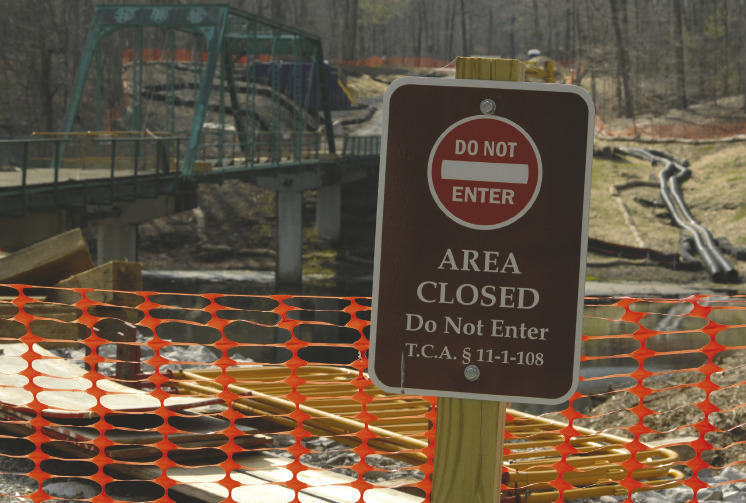
C off ee County Chancery Court recently ruled to uphold a water alteration permit needed for an ongoing Old Stone Fort Bridge replacement project at the state park.
The ruling handed down on February 6 by Judge Will Lockhart upholds a previous ruling from an administrative hearing issued Aug. 21. 2025 that upheld an ARAP permit by the Tennessee Department of Environment and Conservation (TDEC) to a portion of the banks of the Duck River to allow construction.
The Old Stone Fort Bridge Preservation Group challenge the permit in May of 2025 with an appeal citing environmental concerns and that the state should have taken into consideration refurbishment of the bridge as a practicable alternative.
“… (T)he court finds that TDEC and the Board properly determined refurbishment of the Campground Lane Bridge was not a practicable alternative … and was supported by sufficient material evidence in the administrative record,” the Final Memorandum and Order states.
The court also held that costs are to be taxed to the Bridge Group.
During the Bridge Groups’ oral arguments, attorney Jason Holleman, of Holleman Law Group, challenged the permit by alleging that that the work authorized by the permit constitutes more than de minimis (minimal) degradation, and that TDEC failed to consider practicable alternatives to replacing the Campground Lane Bridge.
Lockhart upheld the previous judge’s ruling that the “OSFB Preservation Group failed to meet its burden of proof as to both of its assertions.”
The de minimus argument was rejected by Lockhart at the time of the hearing saying that the environmental impact covers only a portion that falls within the definition of minimal impact.
The initial hearing took the argument further by calling the OSFB Preservation Group ARAP expert’s testimony significantly undercut by his reliance on incorrect facts.
Holleman argued before Chancery Court that the state defined the purpose of the project so narrowly as to exclude refurbishment as an option.
Lockhart rejected the argument, saying that the petition offers no purpose other than what is within the permit. That overall purpose is to replace the bridge to meet current TDOT standards. This upholds the previous refurbishment would leave old weight restricted parts resulting in a posted weight limit.
When the bridge was still in use for vehicles, it had a posted weight limit, which was likely not followed, leading to the damage of the bridge and ultimately its closure. Refurbishing the bridge would only recreate that situation.
Thus, it ruled, OSFB Preservation Group’s proposal to refurbish the bridge is not a practicable alternative, and TDEC was not required to consider it in issuing the permit.
The funding for the legal challenges to the project, according to previous year’s tax records, comes mostly from private donations, with the exception of a $36,000 contribution by Coffee County government.
During the Sept. 25, 2025 Budget and Finance meeting, Old Stone Fort Bridge Preservation Group President Matthew Wiser requested $16,000 for fees owed and estimated $20,000 more in fees to save the bridge, according to the meeting minutes.
A motion was made by Commissioner Tim Brown to up that to $36,000 from the Tourism fund and was seconded by Commissioner Todd Malone. That motion carried. The full County Commission approved the funds with Commissioner Dwight Miller offering the sole no vote.
In the Budget and Finance meeting, County Mayor Dennis Hunt, a member of the Bridge Preservation Group, called the project the best use of Tourism dollars that he can think of.
“The Stone Fort Preservation Group as you all know have fought extremely hard in the courts and in the public opinion and have been pretty successful so far,” he said, just over a month after the administrative judge had rejected the appeal.
Former Bridge Preservation Group President Gary Kiviniemi told the Times in his opinion, “that TDEC officials have lied, manipulated, conspired, ignored experts, failed to reinspect, failed to legally provide public information, and destroyed the people’s faith in government.”
“They have refused the requests of our many local leaders – all in an effort to support their corruption – cover their lies and mistakes – while wasting millions of dollars, a wonderful, beloved park asset and destroy the environment they are pledged to protect. The process is in place to force decisions in favor of the Agency, where administrative reviews never are found in favor of the public rightfully challenging waste.”
He further called Lockhart “a gutless judge” who “rolled over to political and job consequences.”
Current group president Matthew Wiser said the group is quite disappointed in the ruling regarding the ARAP.
“We also look forward to continuing to work with our legislators to make clearly necessary changes to our laws including, at the very least, a requirement that state agencies at least attempt mediation when a case is brought against them regarding a project on public property with public funds,” he said.
“There is overwhelming support to rehab and keep the bridge, but state agencies have been deaf to listening to any concerns including the Stormwater Pollution Protection Plan failed requirements during initial site work in 2025.”
“We remain hopeful that they will provide that opportunity now due to the number and seriousness of unaddressed issues with this project and the federal permitting and funding documents.” he said.
Wiser said there are no additional fees or outstanding balance due to the courts.