October 6, 2026

New Union teacher faces breast cancer battle with faith
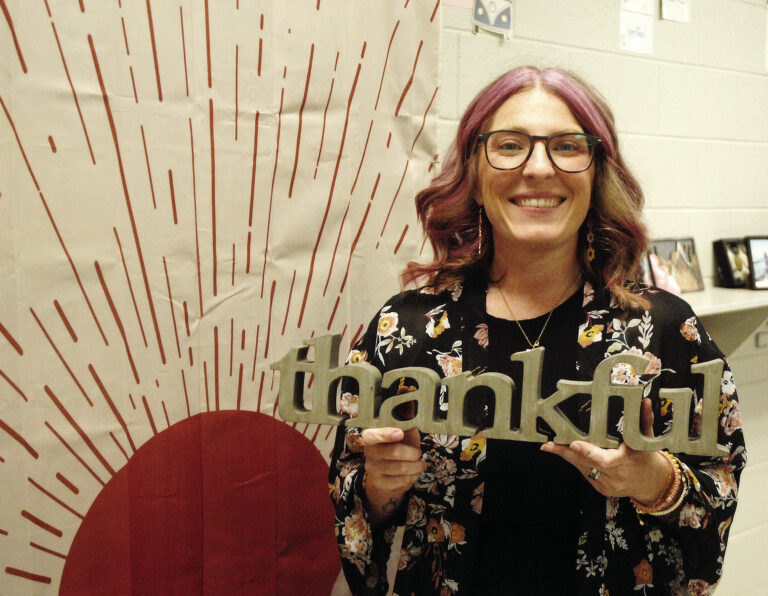
ew Union Elementary School third grade teacher Amanda McCain was very recently diagnosed with an aggressive form of breast cancer, triple negative invasive ductile carcinoma.
“I don’t think it has really hit me completely yet,” she said. “I think it would have hit me harder if I didn’t have such a good community.”
“This community has been phenomenal. The parents of my students made me a massive basket, gift cards, they are doing a t-shirt fundraiser… my cross-country team is going to wear shirts that say We Run For McCain.”
McCain goes for her PET scans this week, but even this early in, she has gotten a look at what the remainder of this school year will look like.
“For me having a game plan helps my anxiety know it’s going to be okay,” she said.
“I’ll be doing 12 weeks of chemotherapy and immunotherapy and then another 12-weeks of chemotherapy and immune therapy mixed in with a medicine they call the Red Devil because it will make me so sick,” she said.
After six months of chemo and immunotherapy, McCain will be scanned again and then at the end of the school year, there could be surgery and potentially radiation therapy.
In addition to the support of her community, McCain braces herself for the grueling months ahead with her faith.
“I’ve always said I was God’s favorite, so despite all this, God has a purpose for what I’m going through, and my goal is that his glory shines throughout the whole thing. My faith has really helped me not see it too negatively and be more positively.”
“The community has really kept me accountable for my faith. I have always been really open about my faith. So now being on the spotlight with it has really helped really – this is my ministry.”
McCain’s diagnosis comes after a decade of wellness checks and mammograms.
Doctors knew of an abnormality in her breast for several years, but the spot did not meet the criteria and had even become less of a concern. This year, however, the spot had changed. The walls of the spot that been smooth, which shows it to be benign, had come to resemble lightning bolts characteristic of the rapidly multiplying cancer cells.
“We are trying to figure out if that was the same thing that came back over the last several years,” she said.
Since the diagnosis a few weeks ago, McCain has been working out lesson plans for her classroom and the inevitable absences that will be necessary. During the first 12 weeks she will miss the days she goes in for chemotherapy.
The immunotherapy can be something of an unknown. The medicine will turn McCain’s immune system on the cancer, but there is a real and dangerous possibility that her immune system targets a heathy system like a kidney, the liver or a lung, so she has to be hyperaware of any cough, stomachache or headache that could indicate the therapy is trying to kill her.
“My plan for the first 12-weeks is to work on the days that I feel good. I’ve been working on my lesson plans for the whole year, so anyone can walk in and click my slides and do what I need to,” she said.
During the second half of the treatment, McCain’s immune system will be so low that teaching will not be possible.
“I will be wearing a mask while I am at school. My students know that if I’m not here it’s not because I don’t want to be here, it’s because I have to take care of me. I can’t be here if I don’t take care of me.”
McCain’s diagnosis and treatment opened up some difficult conversations with her class.
“I got my diagnosis phone call last Monday, at 7:50 (a.m.). My students saw that I was upset, but I told them it was something personal because I did not want to let them know first.
After school McCain messaged all the parents to share what the doctors had told her so they could talk to them first.
“I brought them together each class separately, told them what my diagnosis was and asked them if they knew anything about cancer and then asked them if they had any questions.”
The questions mostly centered on will she get really sick, will she be at school, will you lose your hair, but kids being kids, one asked will “will cancer make you die?”
McCain called the discussion a really good way to explore the things going on through their minds.
“The question about will you die, another student interjected and said ‘I hope not but if she does, she’s going to heaven. So, what’s better than Earth? Heaven,” Mc-Cain recounted the student saying.
Last Wednesday after getting her treatment plan from the oncologist, she returned to school to share with the class what the schedule would look like.
“We talked about it and what it would look like for them for the rest of the school year,” she said.
“Mrs. McCain is going to get sick, she’s going to lose her hair, and she can’t compromise her immune system,” McCain explained to her class. “If I’m not here, I love you and I’m going to miss you, but I have to keep myself safe.”
“I think they understand. I dyed my hair pink last night because they know I’m going to lose my hair. A lot of the girls had pink clips in.
McCain’s doctors told her that because her cancer is not hormone receptive that once she’s done with chemo and radiation and the cancer’s gone, the chances of it returning are low. If it were a hormone receptor type, she would have to be on medicine to block those hormones from feeding the cancer.
McCain said her mother’s breast cancer opened her to be an early screener. She worries for the women who are unable to be screened in their 30s. The said the number of women in their 30s getting breast cancer is increasing.
“We need to somehow change that for early screeners. What would have happened if I skipped my mammogram this year? If I’d gotten too busy, what would have happened by this time next year?”